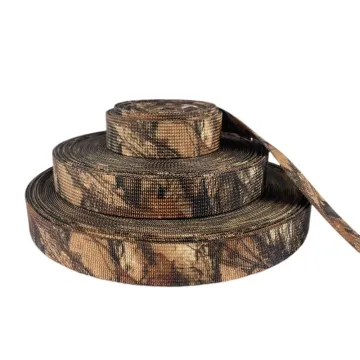
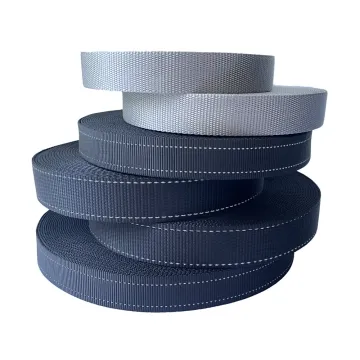
Double sided logo webbing
A reversible strap needs a drawing for each face. Show whether the reverse repeats, mirrors or changes the logo, and where both faces meet at folds.
Content updated
In this guide
Key choices for your project
State whether both faces must read in the same direction when laid flat or after assembly. These are not always the same requirement. Mark face A, face B and the strap ends on the drawing, then approve a full repeat on both sides.
- Reading direction on each face
- Alignment between faces
- Logo orientation after folding
Two logo faces can disagree after folding
Imagine reversible webbing with both logo faces clear on a flat sample. Around a curved edge, the contrasting reverse peeks past the border. At a return, one logo reads upside down because the sample was reversed during approval. Both artworks were correct, but orientation and edge behaviour were undefined.
Label the start and face A before reviewing a full repeat. Turn it over without rotating the ends and inspect face B from the same datum. Thread, bend and fold the tape in its finished direction, checking registration, reverse show-through, edge colour and logo reading at each visible position.
Approve both labelled faces, their common edge and the finished folding direction on a full-repeat assembled sample.
Decide what the edge should reveal from the opposite face
Choose whether the edge yarn matches face A, face B or acts as a neutral border. On a reversible strap, a contrasting reverse can peek around a curved edge or folded return even when the faces are aligned. Approve both flat and bent views and include the edge treatment in the colour drawing.
- Edge colour in flat and bent positions
- Reverse-face show-through at folded returns
Inspect both faces without losing orientation
Label the start end and face A on every approval sample. Inspect a full repeat on one face, turn it over without rotating end for end, and inspect face B against the same datum. This simple sequence prevents a mirrored or reversed sample from being accepted because the reviewer unknowingly changed orientation.
- Start-end datum retained while turning the sample
- Full repeat inspected on each labelled face
Define two faces around one tape
Clarify whether both faces carry controlled logos, one face is primary, or the reverse only needs to be usable.
Swipe to see all columns ↔
| Field | What to record | How to confirm |
|---|---|---|
| Face A artwork | File revision, scale, colours, repeat, reading direction and start datum | Inspect one labelled full repeat |
| Face B artwork | Independent or related design, scale, colours, repeat and reading direction | Turn over without reversing ends |
| Construction | Fibre, weave or print route, finished width, thickness and hand | Retain an identified trial |
| Face registration | Required alignment, acceptable offset and reference points between faces | Measure from the common datum |
| Edge treatment | Edge yarn or print colour, neutral border and permitted reverse show-through | Review flat and smallest bend |
| Product orientation | Hardware route, twists, folds, seams and visible face at each zone | Build the complete strap layout |
“Double-sided” must be defined in the quotation; it can describe several different constructions and approval obligations.
Download specification worksheet ↓Keep orientation while reviewing both faces
Label the shared datum
Mark start end, face A, face B and reading direction on artwork, woven trial and every retained approval sample.
Inspect complete repeats
Review one full repeat on face A, flip without rotating end for end, and review face B against the same reference.
Bend, fold and thread
Route the tape through intended hardware and returns, observing edge colour, reverse reveal, logo direction and registration at curves.
Retain an assembled reference
Photograph each visible product position and keep the labelled full-repeat assembly linked to both artwork revisions and construction identity.
Shortcuts that hide reversible-logo errors
Leaving double-sided undefined
A logo on both faces, independently controlled designs and a usable reverse require different constructions. State the intended result before pricing.
Approving cropped face photographs
Separate close-ups can lose start-end orientation and omit registration drift. Inspect full labelled repeats from one common datum.
Ignoring the edge and returns
A contrasting reverse may show around curves or folds even when faces align. Include edge treatment and finished strap routing in approval.
Questions before you choose
What does “double-sided logo webbing” mean in a supplier quote?
Clarify whether it means a logo visible on both faces, two independently controlled faces, or simply a usable reverse. These are different constructions. Send face-and-reverse artwork and define acceptable floats, colour carry-through, alignment and hand before comparing prices.
How can I keep logos aligned on both sides of the webbing?
Define whether face-to-reverse registration is visually critical and where the strap twists or folds. Review a full repeat, not a cropped photo. For printed faces, check show-through and registration; for jacquard, inspect yarn structure and reverse readability.
Products to start with
Open a product to see its listed specification. Custom colours, dimensions and order terms are confirmed for your project.
More product photos
Tell us what you are making
You can enquire before every detail is settled. Tell us the intended use and what you need help choosing; add dimensions or quantities if you know them.
What happens after your enquiry
We review the intended use and open specification questions first. Sample options, costs, minimum quantities and timing can then be discussed against that brief. Sending an enquiry does not place an order.
Request a relevant sample →