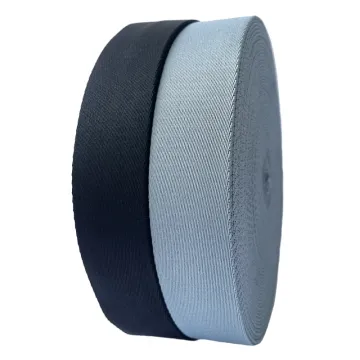
Webbing width and tolerance
The required width comes from the mating part. Measure the narrowest buckle opening and agree a tolerance that also accounts for the webbing edge and production variation.
Content updated
In this guide
Key choices for your project
Write a nominal width and an acceptable range, then agree how many positions are checked. A buckle slot leaves limited clearance, while an exposed trim may need visual consistency. Confirm whether the tolerance applies before finishing, after finishing or to the delivered roll.
- Nominal width and range
- Measurement positions
- Stage at which tolerance applies
Turn nominal width into an inspectable requirement
A label such as 25 mm does not define the acceptable range. State where and how width is measured, the permitted minimum and maximum, and the hardware it must pass through.
Swipe to see the full comparison ↔
| RFQ field | Illustrative entry | Why the buyer needs it |
|---|---|---|
| Nominal width | 25.0 mm | Names the intended size but is not an acceptance limit. |
| Acceptance range | Example only: 24.5–25.5 mm | Gives incoming inspection a clear pass/fail band. |
| Measurement method | Relaxed tape, flat, measured away from the roll edge at agreed points | Prevents tension, curl or location from changing the result. |
| Mating hardware | Actual buckle sample or drawing with usable slot dimensions | Confirms more than nominal width: edge build and slot clearance matter. |
| Sampling plan | Agreed rolls and measurement points per lot | Defines how one result represents a shipment. |
The numbers shown are illustrative, not Sinicwebbing's standard tolerance. Agree the range for the construction and application.
The average width is correct, but the widest section jams the sewing guide
Imagine delivered webbing with the correct nominal width and average. Midway through several rolls, one edge waves and the widest readings jam the folder. One inspector presses the tape flat; another measures its natural curve, so their data disagree.
Start from the narrowest buckle, guide, folder or fixture and minimum required coverage. Define production stage, conditioning, gauge, pressure and roll positions. Test boundary-width samples through the assembly, then apply the agreed minimum, maximum and sampling rule to bulk rather than accepting from an average.
A useful width tolerance combines one repeatable measurement setup with functional upper and lower limits drawn from the actual assembly.
Measure width with one repeatable setup
Define the gauge, tape condition, measurement pressure and distance from the roll end before setting a tolerance. Take readings across several roll positions and report the spread, not only an average. Soft or curved tape can produce different numbers when operators flatten it differently.
- Gauge and handling method
- Spread across defined roll positions
Set the limit from the narrowest assembly point
Measure the actual slot, folder, guide or sewing fixture that constrains the tape and allow for the production stack. Check the widest acceptable tape through that point and the narrowest tape for coverage or grip. This converts a drawing tolerance into a functional acceptance window.
- Maximum width through the tightest point
- Minimum width for coverage or grip
Define a functional width-tolerance record
Connect measurement conditions to both sides of the assembly window.
Swipe to see all columns ↔
| Field | Record | Confirm |
|---|---|---|
| Constrained interfaces | Buckle slot, guide, folder, fixture, seam or coverage point | Measure controlled physical parts |
| Width stage | Before or after finishing, relaxed delivered roll and any conditioning | Name the acceptance stage |
| Measurement setup | Gauge, contact shape, pressure, orientation and handling of curved tape | Demonstrate operator method |
| Sampling positions | Roll selection, distance from ends, positions along each roll and reading count | Mark positions on inspection plan |
| Functional limits | Nominal, minimum for coverage or grip and maximum for passage | Trial boundary samples in assembly |
| Decision rule | Individual limits, treatment of average, invalid readings and recheck | Apply to recorded spread |
Tolerance values and sample frequency are project-defined. Report individual readings and spread; do not use an average to hide an out-of-limit section.
Download specification worksheet ↓Set width limits from measurement and use
Map every constrained point
Measure the actual hardware, folder, guide, seam and visible coverage area. Identify which point controls the maximum and which controls the minimum.
Standardize the width measurement
Agree product stage, conditioning, instrument, pressure, orientation and treatment of curl or waviness. Train inspectors on the same physical demonstration.
Prove both boundary conditions
Run proposed widest tape through the tightest path and the narrowest through required coverage or holding. Include real layer stacks and movement.
Inspect distribution across rolls
Sample the agreed rolls and positions, retain individual values and map local excursions. Apply limit and recheck rules before disposition.
Three tolerance practices that miss assembly failures
Write nominal width only
A target without upper and lower limits cannot govern production variation. Define the functional acceptance window and its measurement stage.
Accept from the average
A correct mean can contain sections too wide for hardware or too narrow for coverage. Judge each required reading under the sampling rule.
Flatten every sample by hand
Unequal tension or pressure changes soft and curved tape readings. Use a defined instrument setup and report curvature separately.
Questions before you choose
Why can two rolls with the same nominal width fit hardware differently?
Nominal width alone omits tolerance, edge shape and measuring condition. Tape may read differently under tension or after relaxation. Specify edge-to-edge method, conditioning, allowed range and the buckle opening, then fit samples from more than one roll in actual hardware.
Should webbing width be measured while pulled straight?
Only with an agreed, repeatable tension. Pulling by hand can narrow flexible tape and hide waviness. State whether measurement is relaxed or lightly tensioned, how long material rests after unwinding and where across the roll the readings are taken.
Products to start with
Open a product to see its listed specification. Custom colours, dimensions and order terms are confirmed for your project.
More product photos
Tell us what you are making
You can enquire before every detail is settled. Tell us the intended use and what you need help choosing; add dimensions or quantities if you know them.
What happens after your enquiry
We review the intended use and open specification questions first. Sample options, costs, minimum quantities and timing can then be discussed against that brief. Sending an enquiry does not place an order.
Request a relevant sample →