Plain weave webbing for production
Plain webbing still varies in yarn size and density. Choose the sample that feeds and sews correctly, then record its weight and dimensions for repeat orders.
Content updated
In this guide
Key choices for your project
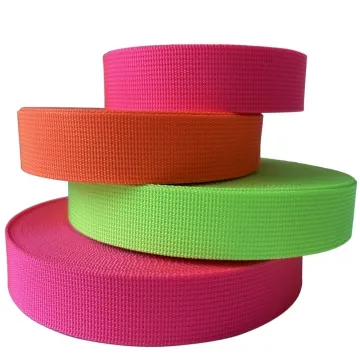
Plain weave gives a useful starting point for comparing density, stiffness and colour without a decorative pattern. It is not a single fixed specification. Keep the weave reference and weight per metre in the order so a later batch does not become a visually similar substitute.
- Weave reference
- Weight per metre
- Bend around the intended hardware
Two plain tapes can match on the roll and separate during sewing and bending
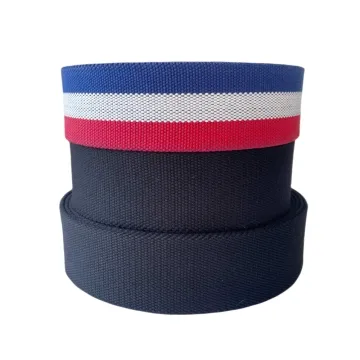
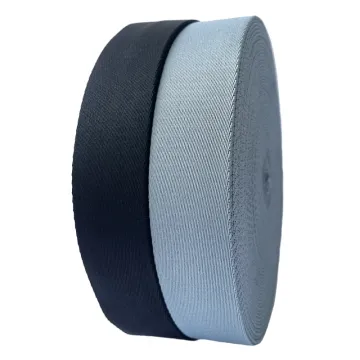
Imagine two black plain-weave candidates that look interchangeable on a dark table. Pulled around a light bag edge, one opens enough to reveal the layer below. Fed through the production guide, the other tracks sideways until the seam approaches one edge. The shared weave name has not controlled yarn size, density, edges or finish.
Compare conditioned samples over the lightest and darkest product backgrounds, both flat and around the tightest intended curve. Record width, thickness, mass per length, edge construction, bow and skew, then sew and cycle each through the actual hardware. Freeze the chosen construction and physical sample together.
Specify plain webbing by its measured construction and assembled behavior; “plain weave” alone is only a broad structural description.
Check coverage when the webbing is pulled over a contrasting layer
Place the candidate over the lightest and darkest material it may cover, then tension it as the product will. An open construction can look solid on the roll yet reveal the layer beneath when stretched around a curve. Approve opacity and surface uniformity in the assembled position, with both background extremes recorded.
- Coverage over the lightest adjacent material
- Open gaps at the tightest product curve
Reject bow and skew that disrupt sewing
Lay a measured length against a straight reference without forcing it flat. Mark any sideways bow or angled crosswise line, then run it through the intended sewing guide. Set an acceptance method with the supplier because visually similar plain tapes can track differently and gradually move the seam toward one edge.
- Sideways bow over the agreed inspection length
- Seam drift through the production sewing guide
Turn a plain-weave sample into a repeatable purchase record
The record captures coverage, tracking and hardware response alongside basic dimensions so later visually similar tape cannot be substituted silently.
Swipe to see all columns ↔
| Field | What to record | How to confirm |
|---|---|---|
| Construction reference | Fiber, yarn appearance, weave density, edge structure, finish and sample code | Compare to a retained approved cutting |
| Conditioned dimensions | Width, thickness and mass per length under the agreed specimen state | Measure several locations with the same procedure |
| Coverage condition | Light and dark backgrounds, applied tension and product curve | Photograph the tape in the assembled position |
| Straightness | Inspection length, sideways bow and crosswise skew observation | Lay freely against a fixed straight reference |
| Production response | Sewing guide, seam tracking, needle and thread, buckle and tape path | Run a representative sewn and hardware-mounted length |
| Release controls | Approved face, color, lot reference and reapproval triggers | Attach the sample code to the order specification |
Acceptance values are project-defined; an approved construction should be rechecked when yarn, density, edge or finish changes.
Download specification worksheet ↓Qualify plain webbing beyond its simple appearance
Define the product demands
List background coverage, curve, hardware path, seam tracking and desired hand before selecting candidates that share only a plain-weave name.
Inspect structure and straightness
Measure conditioned width, thickness and mass, observe edges and density, and lay a free length against straight and crosswise references.
Reproduce product interfaces
Place tape over background extremes, bend it around the intended curve, sew through the production guide and cycle the actual adjuster.
Freeze the proven construction
Retain the physical sample, record construction and process fields and define which yarn, density, edge or finish changes require new approval.
Plain-weave assumptions that invite substitution problems
Treating the weave name as a specification
Plain weave does not fix yarn size, density, thickness, edge or finish. Record the measurable construction and approved sample code.
Approving coverage on the roll
An open tape may look solid while relaxed and reveal a pale layer around a curve. Inspect it under product tension and background.
Ignoring gradual seam drift
Small bow, skew or feeding differences can move a long seam toward an edge. Run the intended guide over a representative length.
Questions before you choose
Is plain-weave webbing the safest default for mass production?
Plain weave is straightforward and widely usable, but the name alone does not guarantee stability, strength or easy sewing. Compare yarn density, thickness, edge construction and finishing. The best default is the construction already proven in the intended buckle, seam and product.
Why do two plain-weave webbings behave differently in the same adjuster?
They may differ in thickness, yarn size, pick density, surface finish and edge firmness even when both are called plain weave. Measure the finished tape and cycle each through the actual adjuster under load before treating them as interchangeable.
Products to start with
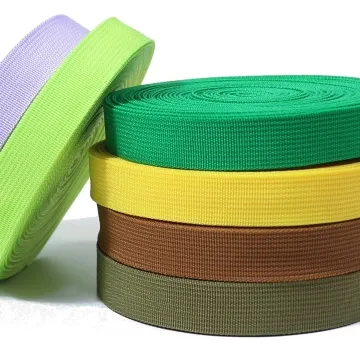
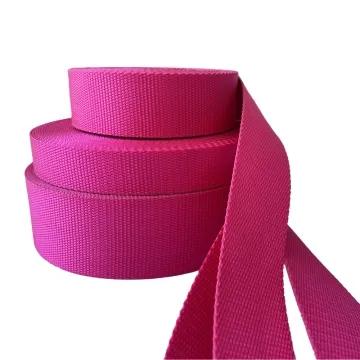
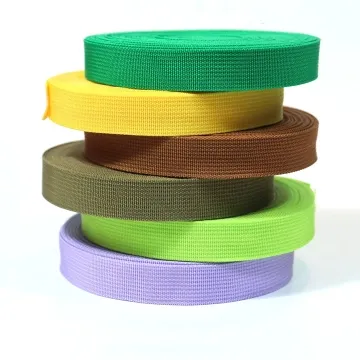
Open a product to see its listed specification. Custom colours, dimensions and order terms are confirmed for your project.
More product photos
Tell us what you are making
You can enquire before every detail is settled. Tell us the intended use and what you need help choosing; add dimensions or quantities if you know them.
What happens after your enquiry
We review the intended use and open specification questions first. Sample options, costs, minimum quantities and timing can then be discussed against that brief. Sending an enquiry does not place an order.
Request a relevant sample →