Webbing components for martingale collar development
A martingale collar combines a main band with a smaller moving loop. Specify both parts and their travel together; a webbing width alone cannot describe the finished mechanism.
Content updated
In this guide
Key choices for your project
For a component enquiry, send a drawing of the main band, moving loop, rings and stops in both relaxed and limiting positions. The brand should define the intended adjustment range and validation requirements. Evaluate the assembly on a suitable fixture before approving material or seam changes; a catalogue webbing is only a starting material reference.
- Main band and moving-loop dimensions
- Ring clearance and defined limiting position
- Complete assembly validation requirements
Separate the two bands in the specification
The main band and moving loop may have different lengths, widths or finishes. Give each a part number and show its threading direction. Record how folded ends and seams consume length. If both parts use the same colour, identify them by their construction code so similar-looking pieces are not interchanged during assembly.
The main band and moving loop cannot be approved as one generic strip
Imagine a martingale-style collar whose main band looks correct when relaxed. During travel to the buyer-defined limiting position, a bulky folded end can enter a ring, the smaller loop can twist, or a seam can reduce the intended movement even though both tapes share the same nominal width.
Give the main band and moving loop separate part identities, then draw the selected rings, folds, seams and stops in relaxed and limiting positions. Build the complete assembly with production-intent finishes and observe its full movement on the buyer's suitable fixture before approving either webbing component.
Control the two bands by their distinct geometry and movement inside the finished collar.
Products to start with
Open a product to see its listed specification. Custom colours, dimensions and order terms are confirmed for your project.
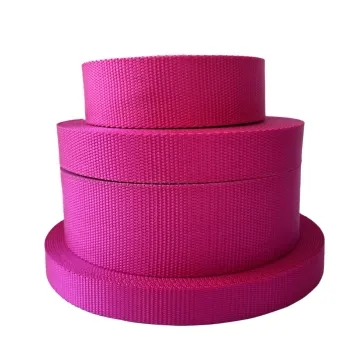
More product photos

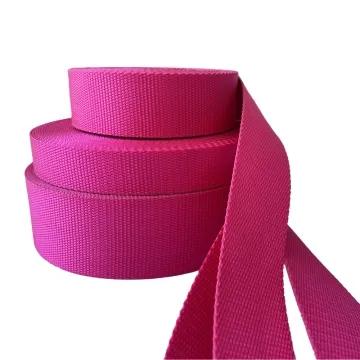
Observe movement through the full travel
Use the selected rings and finished webbing, including printing or coating. Watch for a folded edge catching, a seam entering a ring or a loop twisting as the assembly moves between its defined positions. A changed surface finish can alter sliding behaviour, so colour or coating substitutions need a functional review as well as visual approval.
Describe both bands and the moving mechanism
A component record should reproduce the complete geometry without turning catalogue webbing data into a finished-collar safety claim.
Swipe to see all columns ↔
| Field | What to record | How to confirm |
|---|---|---|
| Main band | Part code, width, thickness, face direction and adjusted length range | Measure the finished band between defined references |
| Moving loop | Separate part code, cut length, finished loop length and threading direction | Lay against its controlled drawing before assembly |
| Rings and sliders | Part identities, internal geometry, finish and orientation | Match actual hardware to drawing and sample record |
| Folds and seams | Fold direction, layer stack, overlap, seam location and bulk | Approve a section view and finished end samples |
| Travel and stops | Relaxed position, buyer-defined limiting position and stop locations | Move a marked assembly on the agreed fixture |
| Buyer validation | Intended product range, inspection method and final acceptance owner | Link results to the buyer's controlled validation plan |
The buyer defines fit, use and acceptance for the finished collar; component information alone does not establish product safety.
Download specification worksheet ↓Develop the two bands as one moving assembly
Draw both limiting positions
Show main band, moving loop, rings, sliders, folds and seams in relaxed and buyer-defined limiting positions. Dimension every change from fixed references.
Prepare identified cut sets
Cut and label each band separately with face and threading direction. Add production-intent finish, hardware and seam allowances so parts cannot be interchanged.
Assemble on a controlled fixture
Build the complete collar and move it repeatedly between defined positions, watching ring entry, seam clearance, edge catching, twisting and stop contact.
Record movement before revision
Photograph both positions and any contact marks, then change only one band, seam or hardware variable per comparison and return results to buyer validation.
Component assumptions that alter collar travel
Treating both bands as one part
Similar colour or width can hide different lengths and threading. Assign separate codes and keep each construction tied to its own drawing.
Ignoring seam entry into a ring
A fold may clear while its finished seam does not. Move the complete sewn end through the selected ring across the full travel.
Calling material selection a safety approval
Webbing and hardware data do not validate fit or use of the collar. Keep final acceptance with the buyer's finished-product process.
Questions before you choose
Can the moving loop use the same webbing as the main band?
Possibly, but their roles differ. Compare bending around the rings, surface friction and finished thickness on the proposed assembly. Confirm the material for each part only after the buyer’s required movement and performance checks are complete.
Does approving a strong webbing prove the collar design is suitable?
No. The complete geometry, limiting position, hardware and seams determine the assembly’s behaviour. The finished-product brand must approve its design and use requirements; a material test does not establish fit or suitability for an animal.
Tell us what you are making
You can enquire before every detail is settled. Tell us the intended use and what you need help choosing; add dimensions or quantities if you know them.
What happens after your enquiry
We review the intended use and open specification questions first. Sample options, costs, minimum quantities and timing can then be discussed against that brief. Sending an enquiry does not place an order.
Request a relevant sample →